
Emérgéntly as a Fractal
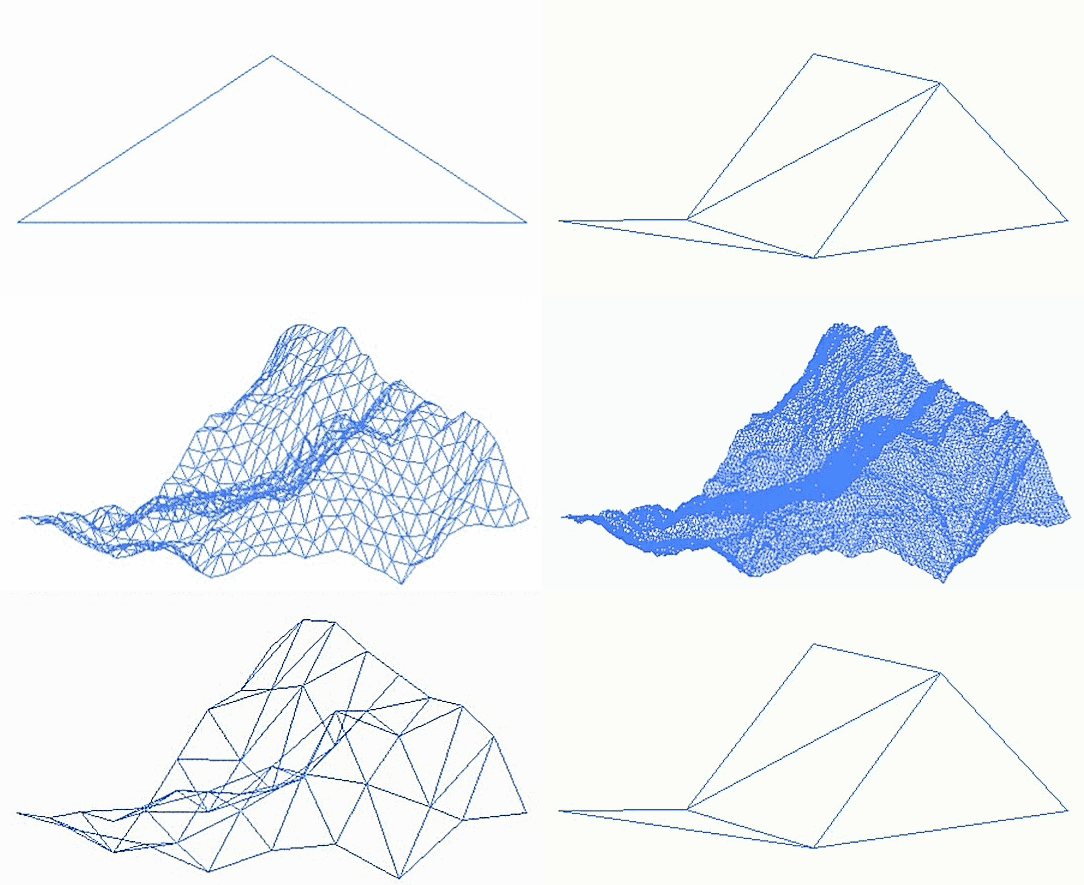
This illustrates how a fractal (repeating pattern) of a triangles with a huge diversity of sizes and angles can create an image of Nature. But it is only two dimensional. Perhaps a three dimensional fractal of tetrahedrons with a huge diversity of sizes and angles could model the structure of Nature — the tetrahedron is the minimum structural system possible:
|

Nature is a totally efficient, self-regenerating system. If we discover the laws that govern this system and live synergistically within them, sustainability will follow and humankind will be a success.
R. Buckminster Fuller
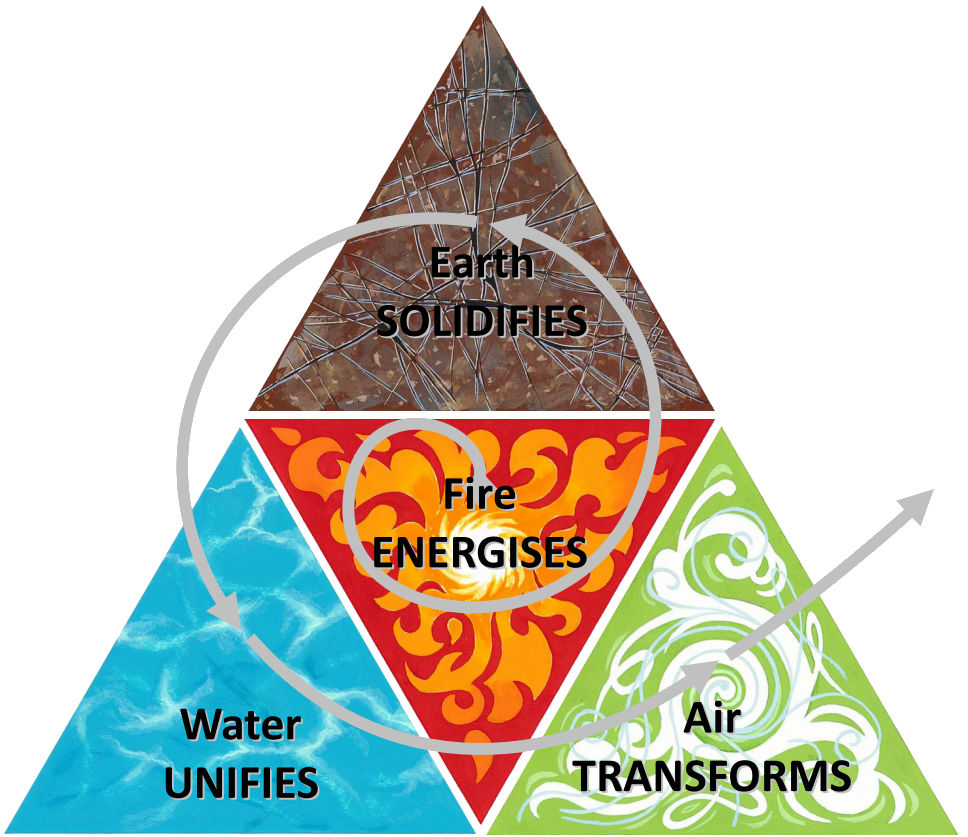 Two dimensional triangles have no opposite sides or angles. The Emérgéntly triangles fold up into a three dimensional tetrahedron, a triangular based pyramid, which also has no opposite sides or angles. Each face of the tetrahedron shares an edge with every other face, so they are all equally interconnected - equally interdependent. According to Buckminster Fuller, the tetrahedron is the way Nature works. In fact, there is an Emergence Theory that reality is built from tetrahedrons.
Carbon is the basis for all life on Earth and the carbon atom always has four relationships with other atoms (it is tetravalent). Carbon is an extremely abundant element by mass in the universe (after hydrogen, helium, and oxygen) so the repeating pattern of fourness probably pervades the entire universe.
|
Emérgéntly seems to be a fractal (repeating pattern) of relationships within a system e.g. organisation. |
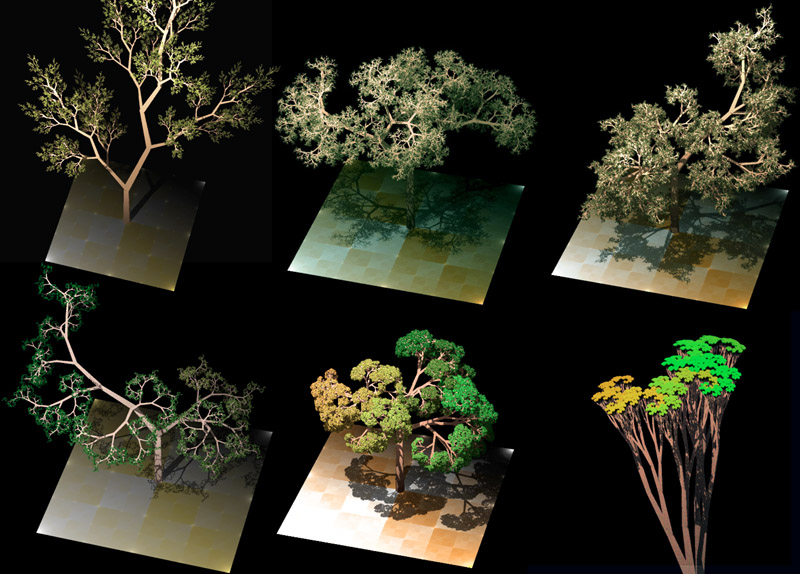
| These tree images were generated with software. The fractal used is a varied dragon curve. See Wikipedia | Hubble-Space-Telescope-Galaxy-Collection. See Wikipedia |
 |
|

Four-Phase Dynamics in Complex Systems
According to a Review in the August 2019 issue of, Ecological Complexity, panarchy (nested adaptive cycles) has been used as a metaphor and conceptual tool for understanding long-term dynamics of change in complex systems like ecosystems and social–ecological systems.
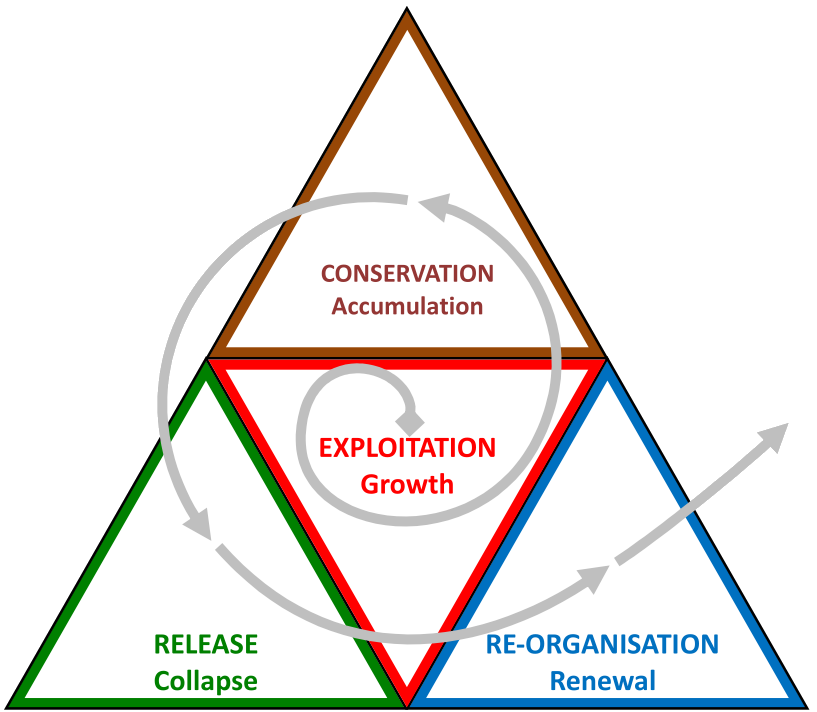 Complex systems like forests, cities, customers or teams follow repeating cycles of four phases
- Exploitaton/Growth
- Conservation/Accumulation
- Release/Collapse
- Reorganization/Renewal
And these cycles happen at many nested scales at once e.g. small patches inside a whole landscape, teams inside a company, etc. Understanding these cycles helps predict when a system is becoming fragile and how it might change after a shock. Resilience depends more on how the system is organized and how parts interact across scales than on any single component — systems can keep working even if individual parts change.
Forest:
- Growth — young trees rapidly fill open space after a fire.
- Accumulation— mature forest stores lots of biomass and seeds.
- Collapse — a big fire or pest outbreak suddenly clears canopy.
- Renewal— new seedlings and different species colonize, starting a new growth phase.
Action: monitor tree age structure, fuel buildup, and seed sources to detect rising fire risk and guide controlled burns or planting.
Small business:
- Growth — rapid customer and staff expansion.
- Conservation — stable processes, accumulated cash, less innovation.
- Collapse — sudden market change or loss of a key client causes sharp decline.
- Reorganization — pivoting to a new product or restructuring staff, then growing again.
Action: track cash flow, customer churn, and innovation rate to notice fragility and trigger changes earlier.
More:
- Article: Fractal Leadership Just as in a mathematical fractal, the organization as a whole must work on alignment, its departments must work on alignment, its groups must work on alignment, and so on down the chain.
- Article: A System Engineering and Fractal Approach to Leadership Viewing leadership fractally emphasizes how self, team, and organizational leadership are interconnected and interdependent.
- Research: Fractals of strategic coherence in a successful nonprofit organization Complexity theory and fractal processes help us understand the generation of strategic coherence.
- Research: Fractality in Four Dimensions: A Framework for Understanding Organizations as Fractal Entities The correct level of dimensionality is essential to the aim of building a robust conceptual model. Nevertheless, despite the difference in complexity, fractal processes in human organizations are fundamentally the same as those in the natural world.
Next: Ideas in Practice
When you put an idea into practice in a place-time context, things get complicated. Bucky likes the example of drawing a triangle on the ground (on the earth).